
AI Agents
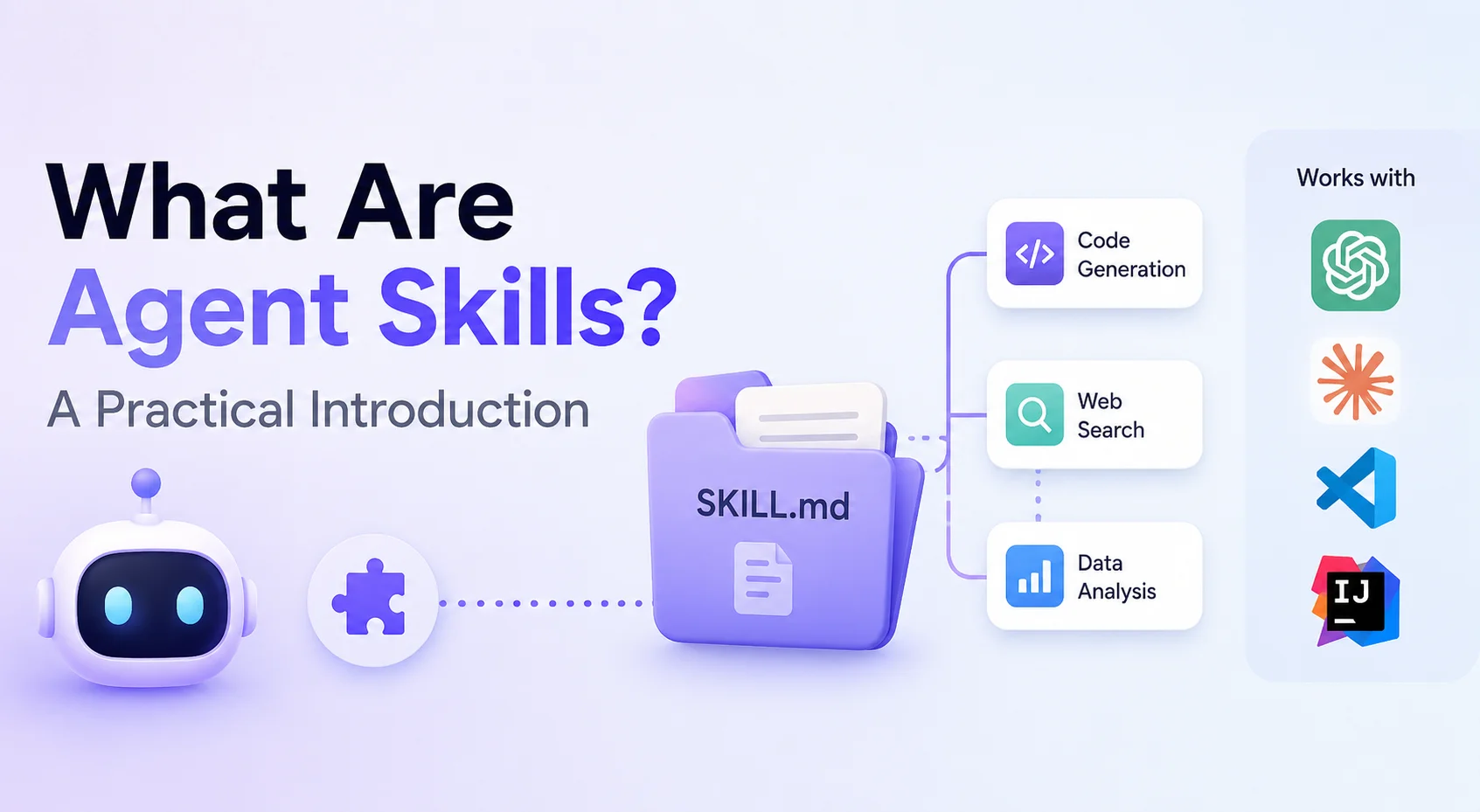
If you use Cursor, Claude Code, GitHub Copilot, Gemini CLI, or any of the growing list of agentic development tools, you have probably seen “skills” mentioned in release notes and documentation. Behind many of those implementations is the same idea: Agent Skills — a lightweight, portable way to give an AI agent new capabilities without hard-coding prompts into every project. This post explains what Agent Skills are, how they work under the hood, and why they matter for teams that want consistent, reusable agent behaviour across tools and repositories.
According to the overview at agentskills.io, Agent Skills are a standardized way to give AI agents new capabilities and expertise. Concretely, a skill is usually a folder that contains a SKILL.md file. That file carries metadata (at minimum a name and description) plus instructions that tell the agent how to perform a specific task. The folder can also bundle scripts, reference docs, templates, and other assets the agent may load when the skill is active.
This is deliberately simple: version-control the folder, share it across repos, and let any compatible agent discover and use the same skill. The format was originally developed by Anthropic, released as an open standard, and has been adopted across a wide ecosystem of agents and IDEs — so skills you invest in are less likely to be locked to a single vendor’s proprietary prompt format.
The mental model from the official site is a small package, not a monolithic app:
The required piece is SKILL.md. Everything else is optional but powerful: a skill can ship a checklist for code review, a data-pipeline recipe, a company-specific API usage guide, or a script the agent is allowed to run when the user approves. That separation — thin discovery metadata vs. heavy instructions and files — is what makes the pattern scale to many skills without blowing context limits.
One of the most important design choices in Agent Skills is progressive disclosure. Agents do not load every line of every skill at startup. The site describes three stages:
SKILL.md instructions into context.That flow keeps the “always on” context small while still allowing deep, procedural guidance when it matters. For enterprise teams, it is the difference between a bloated system prompt nobody maintains and a library of small, reviewable capability modules.
Capable models are not enough on their own; agents often lack the procedural and organisational context to complete work reliably. Skills address that by packaging domain knowledge and repeatable workflows into portable folders you can govern like code: pull requests, reviews, semver, and ownership. Benefits called out on the official site include:
The Agent Skills hub links to a full documentation index for discovery, the specification for the file format, a quickstart to build your first skill, and community channels including GitHub and Discord. If you are standardising agent behaviour across engineers and projects, starting from the open spec beats ad-hoc markdown scattered in chat threads.
At Infurotech, we treat skills (and their equivalents in client stacks) as part of governed agent design: clear scope, explicit instructions, optional automation, and integration boundaries that match your security model. Whether you are adopting Agent Skills in the IDE or wiring agents into ERP and internal APIs, the same principle applies — procedural knowledge belongs in versioned artefacts, not only in prompts.
If you want help defining skills, integrations, or production agent workflows for your organisation, contact us or explore our AI team and automation capabilities.
The tooling landscape will keep changing; an open, folder-based skill format gives you a stable layer to invest in while models and clients evolve around it.