
AI Agents
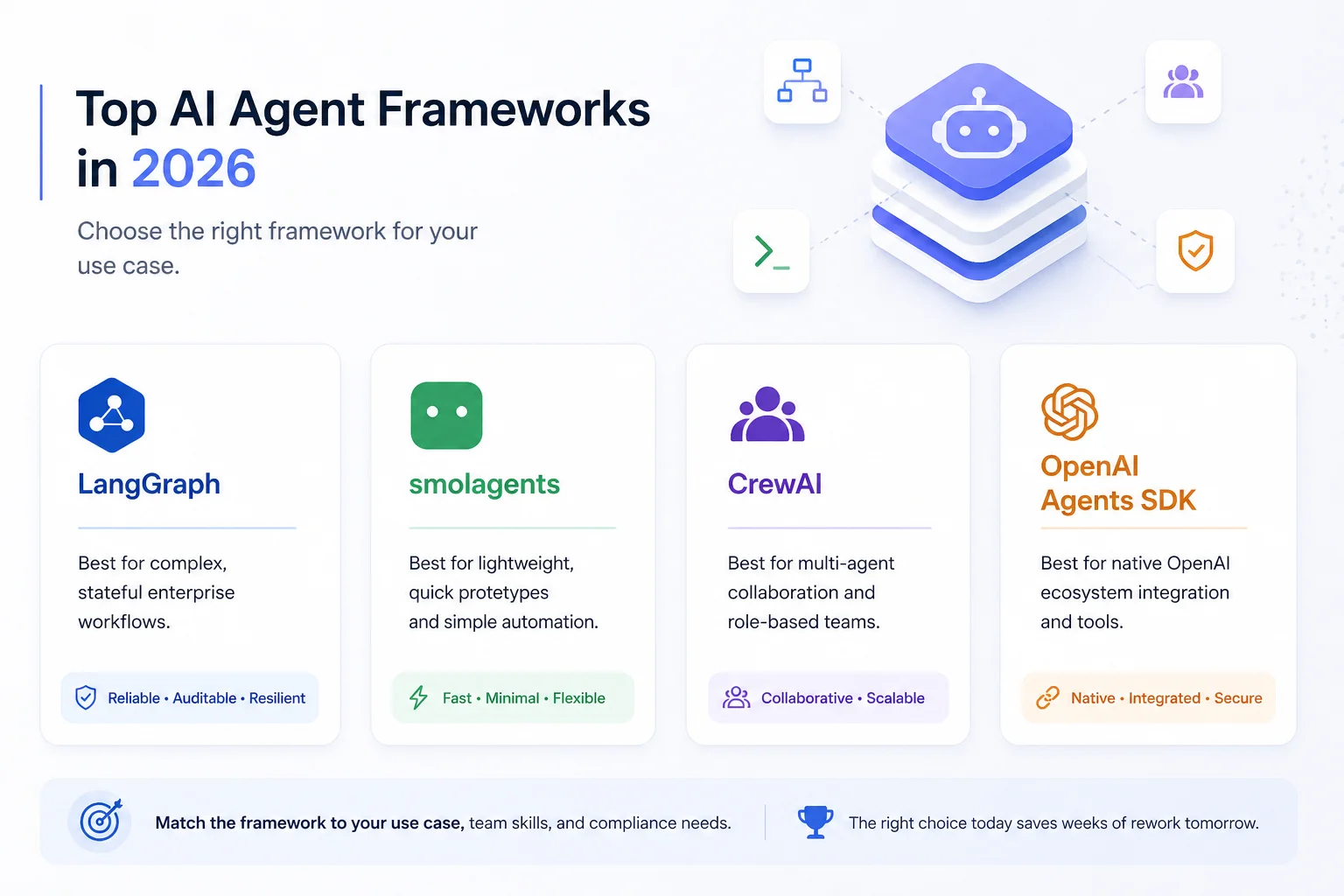
The phrase "build an AI agent" used to mean months of infrastructure work — custom orchestration layers, hand-rolled memory systems, bespoke tool-calling implementations. That changed fast. By January 2026, a handful of frameworks have matured to the point where an engineering team can go from idea to a production-grade agent in days. The problem is not a shortage of options — it is knowing which one to pick.
This comparison covers the four frameworks that matter for Indian enterprise engineering teams in 2026: LangGraph, smolagents, CrewAI, and the OpenAI Agents SDK. Each has a genuine use case. Choosing the wrong one adds weeks of rework later. Here is the decision framework your team needs.
A large language model on its own is stateless and single-turn. You send a message, it responds, the conversation ends. Building an agent that can plan a multi-step task, remember what it did in previous steps, call external tools, recover from errors, and hand off work to another agent requires orchestration logic that is non-trivial to build from scratch.
Agent frameworks provide that infrastructure: state management, tool routing, memory, retry logic, observability, and in some cases multi-agent coordination. The right framework removes 80% of the plumbing and lets your team focus on the business logic of the agent itself.
The wrong framework — one that doesn't fit your use case — adds complexity rather than removing it. That's the mistake teams make when they choose based on GitHub stars rather than requirements.
LangGraph surpassed CrewAI in enterprise adoption during Q4 2025 and is now the dominant framework for production agent deployments in large organisations. It was purpose-built for workflows that need to be deterministic, auditable, and resilient.
The core abstraction in LangGraph is a state graph: you define nodes (tasks) and edges (transitions between tasks), and the framework manages state as it flows through the graph. This means every action the agent takes is explicit, logged, and reversible — you can pause execution, inspect state, roll back to a previous node, and replay from there.
What LangGraph is best for:
Trade-offs: LangGraph has a steeper learning curve than lighter frameworks. The graph-based mental model takes time to internalise. For simple, linear agents, it is overkill. For anything complex, the structure it imposes is worth the upfront investment.
For Indian enterprises in BFSI, healthcare, or manufacturing — where compliance, auditability, and governance are non-negotiable — LangGraph is typically the right foundation.
Hugging Face's smolagents hit over 26,000 GitHub stars in January 2026 following a significant update, driven by a simple proposition: the framework is approximately 1,000 lines of Python. You can read the entire source in an afternoon. There is no magic, no hidden state, no abstractions that obscure what is actually happening.
smolagents is code-first: its agents write and execute Python code to complete tasks, rather than calling predefined tools. This makes it unusually flexible — an agent can do anything Python can do, which is effectively anything. It also makes it particularly well-suited to data analysis, scripting, and research tasks where the exact operations needed are not known in advance.
What smolagents is best for:
Trade-offs: smolagents is not designed for production enterprise deployments at scale. It lacks the state management, human-in-the-loop controls, and observability infrastructure that enterprise workflows require. Use it to validate an agent concept quickly, then consider migrating to LangGraph if the use case warrants production deployment.
CrewAI takes a different conceptual approach: instead of a single agent doing everything, you define a crew of agents — each with a role, a goal, and a set of tools — and they collaborate to complete a larger task. A "Research Director" agent coordinates a "Data Analyst" agent and a "Report Writer" agent, for example.
This role-based model maps naturally onto how teams work in organisations, which makes it intuitive to design and easy to explain to non-technical stakeholders. It also enables genuine parallelism — multiple agents working on different subtasks simultaneously — which can significantly reduce end-to-end time for complex tasks.
What CrewAI is best for:
Trade-offs: CrewAI's role-based abstraction works well for collaborative tasks but is less suited to sequential, stateful workflows where one step must complete before the next can begin. For document processing pipelines or approval workflows, LangGraph's explicit graph structure is a better fit.
OpenAI launched its official Agents SDK in January 2026 with native support for the Agent-to-Agent (A2A) protocol — a new standard for communication between AI agents built on different frameworks and by different providers. This matters more than the framework itself.
The OpenAI Agents SDK is tightly integrated with the OpenAI model family — GPT-4o, o3, and the upcoming o4 series — and provides first-party tooling for function calling, file management, and code execution within the OpenAI ecosystem. If your team has already standardised on OpenAI models and is building within that ecosystem, the SDK provides the cleanest integration path.
What the OpenAI Agents SDK is best for:
Trade-offs: If you use Claude or Gemini as your primary model, the OpenAI Agents SDK adds an unnecessary dependency. Framework-agnostic options like LangGraph work with any model, including Claude, Gemini, and open-weight models like Llama 4.
A development that deserves attention is the emergence of the Agent-to-Agent (A2A) protocol as a potential standard for how agents communicate across frameworks and providers. In January 2026, both OpenAI and several third-party framework maintainers announced support for A2A.
The implication for enterprises: you may not need to bet on a single framework forever. If A2A achieves broad adoption, an agent built in LangGraph could hand off a subtask to an agent built in the OpenAI SDK, which could return results to a CrewAI coordinator. This is not fully production-ready today, but it changes the strategic calculus for teams worried about framework lock-in.
For now, the practical advice is: choose the framework that fits your use case and team, but design your agents' inputs and outputs to be framework-agnostic where possible.
| Use Case | Recommended Framework | Reason |
|---|---|---|
| Invoice processing or approval workflows | LangGraph | Stateful, auditable, handles branching and exceptions |
| Research and analysis agent (ad hoc) | smolagents | Fast to build, code-first flexibility |
| Rapid prototype for stakeholder demo | CrewAI or smolagents | Quick setup, intuitive mental model |
| Multi-agent content pipeline | CrewAI | Parallel role-based execution |
| Production enterprise agent on OpenAI models | OpenAI Agents SDK + LangGraph | Native tooling + enterprise structure |
| Compliance-sensitive workflow (BFSI, healthcare) | LangGraph | Audit trails, rollback, human-in-the-loop checkpoints |
| High-volume automation at scale | LangGraph or custom | Durable state, monitoring, failure recovery |
Our team at Infurotech does not have a framework dogma. We start with the use case and work backwards to the stack. For most complex enterprise agent deployments, that leads us to LangGraph as the backbone — its state management and observability characteristics align with what regulated enterprises need. For rapid prototyping phases, smolagents lets us validate an agent's feasibility in hours before investing in a full production build.
What we see consistently is that teams that choose a framework based on popularity or tutorial availability end up rebuilding significant portions of their agents when they hit production requirements. Audit trails, human review checkpoints, retry logic, and observability are not afterthoughts — they are structural decisions that are expensive to retrofit.
If your engineering team is evaluating frameworks for an enterprise agent deployment, our technology services team can accelerate that evaluation significantly. If you want to understand how agent architectures fit into a broader AI strategy for your organisation, we can help with that too.
The frameworks are ready. The question is which one gets your most valuable use case into production first. Infurotech's AI Builder has done this across sectors — from process automation to document intelligence to customer-facing AI applications. Talk to our team and let's build the right thing.