
AI Consulting
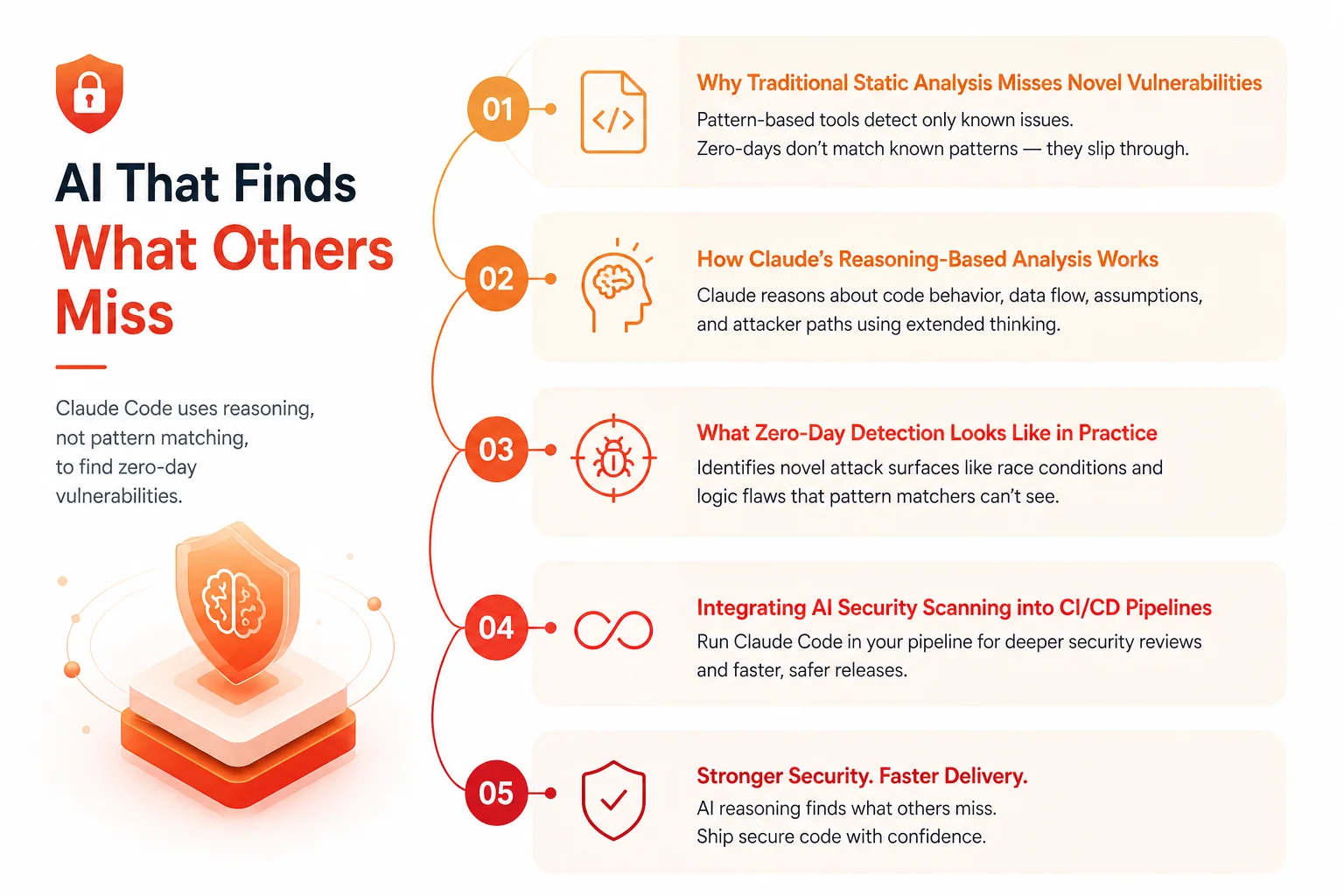
Security reviews are the slowest step in most Indian software delivery pipelines. Not because engineers are slow — because traditional security tooling is fundamentally limited. Static analysis scanners match code patterns against a database of known vulnerabilities. If the vulnerability has been seen before and catalogued, the scanner finds it. If it hasn't, the scanner passes the code as clean.
Zero-day vulnerabilities — by definition — are the ones that haven't been seen before. They are the ones that cause actual breaches. And traditional static analysis is almost useless at finding them.
On February 20, 2026, Anthropic released a security analysis capability in Claude Code that takes a fundamentally different approach: instead of pattern matching, it reasons about code behaviour. The result is the first AI-powered tool capable of identifying novel attack surfaces that have never appeared in any training database.
Static analysis tools — SonarQube, Checkmarx, Snyk, Semgrep — work by comparing code against a ruleset. The ruleset describes known vulnerability patterns: SQL concatenation that could enable injection, unsanitised user input passed to system calls, hardcoded credentials, known-vulnerable library versions.
These tools are valuable. They catch well-understood vulnerabilities reliably and at scale. Every team should use them. But their fundamental limitation is that they know only what they have been taught. A novel vulnerability pattern — a new way of exploiting an API interaction, a subtle race condition in a specific concurrency pattern, a permission escalation in a framework that has never been studied — will pass through pattern-matching analysis without a flag.
This limitation is not a gap that better rulesets can fully close. Novel vulnerabilities are novel precisely because they do not match known patterns.
Claude Code's security analysis uses extended thinking — the model's multi-step reasoning capability — to analyse code the way a senior security engineer would: by understanding what the code is trying to do, tracing the flow of untrusted data through the system, identifying assumptions the code makes that an attacker could violate, and reasoning about what happens when those assumptions break.
This is not pattern matching. It is code comprehension. The model reads the code, builds an internal representation of its behaviour, and asks security-relevant questions about that behaviour: Where does user-controlled data enter the system? Where does it flow from there? At what points could an attacker manipulate that flow? Does the code make any implicit trust assumptions about data sources, calling contexts, or execution order that could be abused?
The extended thinking capability is particularly important here. A zero-day vulnerability often requires reasoning across multiple files, multiple function calls, and multiple layers of abstraction. The vulnerability might not be visible in any single function — it emerges from the interaction between components. Extended thinking allows Claude to reason across that entire interaction surface in a single analysis pass.
A concrete example: consider an API endpoint in a fintech application that validates a user's account ID against their session before processing a transaction. The validation logic looks correct in isolation. The transaction logic looks correct in isolation. But there is a race condition: if two requests arrive in rapid succession, the second request's transaction processing can begin before the first request's session validation completes. An attacker who can time requests precisely can execute a transaction against an account they do not own.
A pattern-based scanner does not flag this. There is no "race condition in payment API" pattern to match against. A human security engineer who reviews both the validation logic and the transaction processing together — and thinks about concurrent execution — might catch it. Claude's reasoning analysis reviews both together, understands the concurrency model, and identifies the window.
This is the class of vulnerability that reasoning-based analysis catches that pattern matching cannot.
The practical deployment model for Claude Code security analysis in enterprise development workflows:
Trigger a Claude Code security analysis on every pull request that modifies security-sensitive code paths (authentication, payment processing, data access, external API calls). The analysis runs as a CI step and posts findings as PR comments, with severity ratings and remediation suggestions. This catches issues before merge, when the fix cost is lowest.
Weekly or bi-weekly full-codebase security scans using extended thinking for maximum depth. This is slower (extended thinking adds latency) and more expensive than PR scanning, but appropriate for systematic security posture reviews. Schedule it for off-peak hours and route findings to a security dashboard.
For high-stakes releases — major feature launches, changes to payment systems, compliance-relevant modifications — require Claude Code security analysis as a blocking gate before production deployment. No high-severity finding may reach production without a human security engineer's explicit sign-off.
Claude Code security analysis works best as a complement to, not a replacement for, traditional static analysis. Run both: pattern matching catches known vulnerabilities fast and cheaply, reasoning-based analysis catches the novel vulnerabilities that matter most. Feed all findings into a single vulnerability management system.
It is important to be clear about the limitations. AI-powered security analysis — however sophisticated — does not replace human penetration testing for high-risk systems.
Penetration testing involves an adversarial human who can probe the deployed system, observe actual runtime behaviour, chain vulnerabilities across components in ways that static analysis cannot fully anticipate, and apply creative attack thinking that goes beyond what any model has been trained on. For banking systems, payment infrastructure, healthcare data platforms, and any system holding personal data at scale, human penetration testing on a regular schedule remains essential.
What Claude Code security analysis changes is the baseline: by the time a penetration tester engages with your system, the well-understood vulnerabilities and many novel ones will already have been identified and remediated. The penetration tester's time is spent on the hardest problems, not on issues a CI tool should have caught.
Infurotech's QA automation services now include AI-powered security scanning as a standard component of enterprise delivery pipelines. Every application built through our AI Builder service goes through both traditional static analysis and Claude Code reasoning-based security review before production release.
For Indian software teams looking to integrate AI security analysis into existing pipelines, our technology services team can design and implement the integration — from CI/CD pipeline configuration to findings dashboard setup to remediation workflow design. Talk to our team about what a practical AI-enhanced security programme looks like for your development organisation.