
AI Updates
For the past decade, enterprise AI meant one thing: you give the system a question and it gives you an answer. Even the most capable large language models were, at their core, question-answering machines. You typed, it responded, and you went back to your keyboard to act on what it told you.
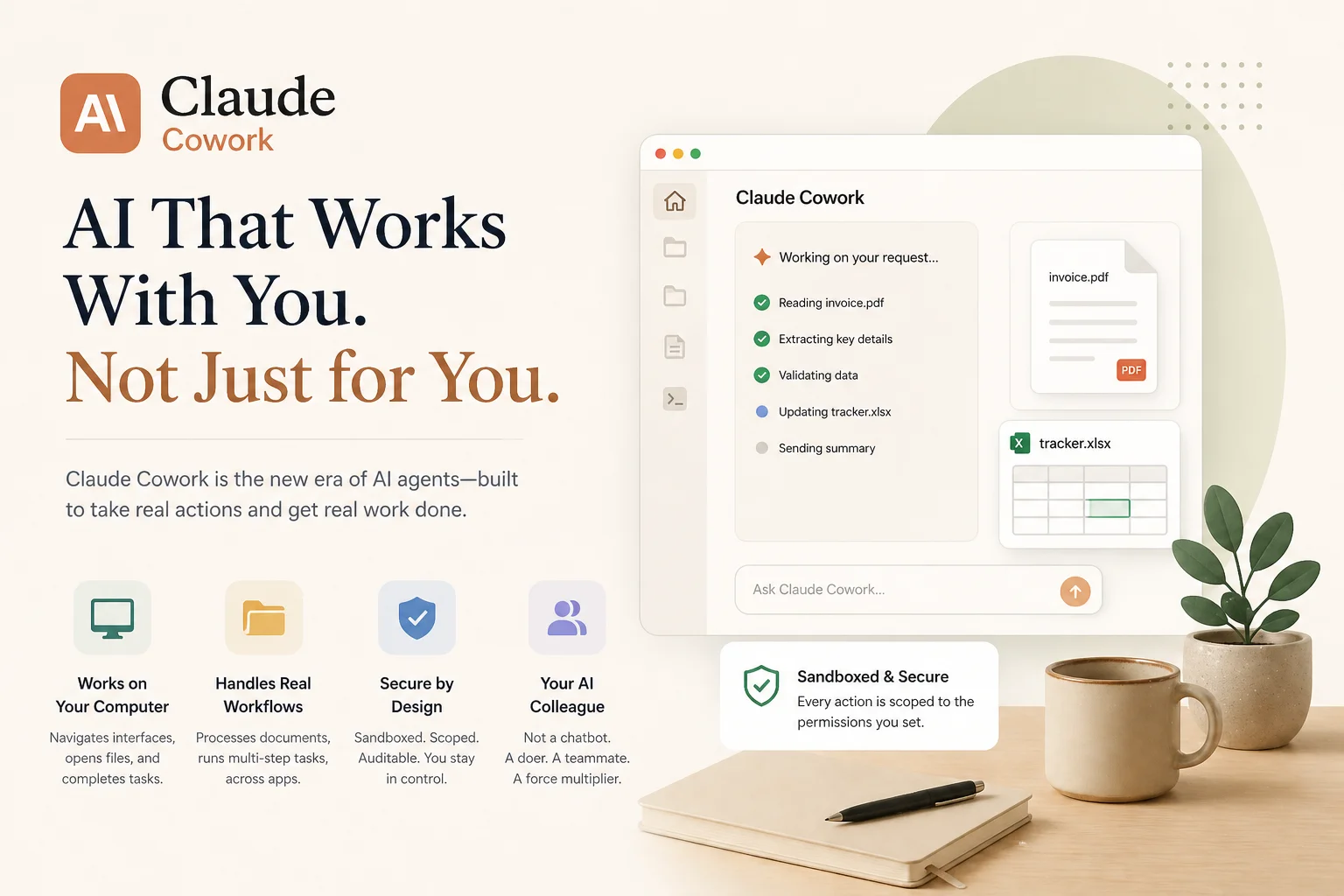
On January 12, 2026, Anthropic changed that equation. Claude Cowork — previewed publicly that week — is not a chatbot. It is an AI agent that can sit at a computer, navigate a graphical interface, open files, process documents, and execute multi-step workflows on your behalf. For Indian enterprises, the implications go well beyond "useful AI assistant." This is the first credible vision of AI as a junior colleague who can actually get work done.
Claude Cowork is a GUI-based autonomous agent built on Claude's core model, designed to take action on a computer — not just respond to prompts. The key distinction from previous AI tools is agency: Cowork doesn't just generate output for a human to act on. It acts itself.
In its initial preview, Cowork ran natively on macOS with a Windows web interface in development. It was built by Claude Code itself in approximately 1.5 weeks — a notable meta-demonstration of the technology's capability. The agent has access to a sandboxed shell environment and local file system integration, which means it can read files, write files, execute commands, and navigate applications that a typical desktop user would operate with a mouse and keyboard.
What Cowork cannot do is equally important. It operates within a defined sandbox — it cannot access systems or data you haven't explicitly authorised. Every action it takes is scoped to the permissions you set. This is not an agent that wanders through your network autonomously; it is an agent that works on the specific tasks, in the specific systems, that you configure it to use.
The preview capabilities cover three broad categories of enterprise work: file and document management, multi-application workflows, and repetitive data processing tasks.
Cowork can navigate a file system, identify relevant documents, extract information from them, and produce structured outputs. An accounts payable team, for example, could instruct Cowork to check an inbound email folder, download attached invoices, extract vendor name, invoice number, line items, and total, and populate a spreadsheet — a task that previously took 20–30 minutes per invoice, done in seconds.
Unlike an M365 Copilot integration that works within a single application, Cowork can chain actions across multiple applications in sequence. It can pull data from a PDF report, cross-reference it against an Excel file, open a web application, and log the results — the kind of task that requires a human to switch context five times and remember what they were doing at each step.
Regulated industries in India — BFSI, healthcare, manufacturing — carry significant compliance documentation burdens. Cowork can read a regulatory filing template, populate it from source documents, verify that all required fields are present, and save the completed document to the correct location. It does not replace a compliance officer's judgment, but it eliminates the clerical component of compliance work that consumes hours every week.
The instinctive reaction from enterprise IT and security teams to an "AI that uses your computer" is concern. That concern is legitimate, but Cowork's architecture addresses it directly.
Every Cowork session runs in an isolated sandbox environment. The agent cannot access files, applications, or systems outside the boundaries you define. Credentials for third-party systems are not stored in the conversation context — they are injected securely at session initiation and scoped to the specific task. All actions taken during a session are logged, creating an audit trail that compliance teams can review.
The security model is closer to a browser extension with defined permissions than to a human employee with broad system access. You control exactly what Cowork can see and touch. It cannot do more than what you've authorised, and it cannot persist state or access across sessions unless you explicitly configure it to do so.
For Indian enterprises with ISO 27001 or SOC 2 requirements, the audit trail and permission-scoping architecture makes Cowork more governable than many existing enterprise software deployments. The key is to design the permission model before deployment, not after.
Indian enterprises that have deployed Robotic Process Automation tools — UIPath, Automation Anywhere, Blue Prism — will immediately ask: how is this different from what we already have? The answer matters for investment decisions.
| Traditional RPA | Claude Cowork | Custom AI Automation | |
|---|---|---|---|
| Setup | Weeks — scripted workflows, brittle to UI changes | Minutes — natural language instructions | Days to weeks — code-based, durable |
| Handles unstructured data? | No — rules-based only | Yes — reads, interprets, adapts | Yes — with model integration |
| Handles exceptions? | No — breaks and waits for human | Yes — reasons through exceptions | Yes — with proper design |
| Scales to high volume? | Yes — built for it | Moderate — designed for task depth, not throughput | Yes — built for it |
| Best for | Structured, high-volume, unchanging processes | Complex, judgment-heavy, document-centric tasks | Custom enterprise workflows at scale |
The practical implication: Cowork is not a replacement for mature RPA deployments on high-volume, highly structured processes. It is a complement — and a replacement for the tasks that RPA was never good at, specifically those requiring judgment, document understanding, or handling of exceptions.
For Indian enterprises that have tried RPA and found it brittle — where a UI change breaks the bot and brings a workflow to a halt — Cowork's language-based approach is significantly more resilient. It understands what it's looking at, not just where to click.
The following use cases represent high-value, practical deployments of Cowork-style agents in the Indian enterprise context.
A Cowork agent monitors an inbound email folder for vendor invoices, extracts structured data from PDF attachments, validates it against purchase orders in your ERP system, flags discrepancies for human review, and creates draft entries for approved invoices. What typically requires a team of 3–5 AP staff to handle 200 invoices per day can be reduced to human oversight of exceptions only.
For BFSI and healthcare organisations, regulatory filings require compiling data from multiple source systems into prescribed templates. A Cowork agent can perform that compilation, populate the template, conduct a completeness check, and deliver a draft for sign-off — turning a 3-hour task into a 15-minute review. This is directly supported by Infurotech's documentation automation service.
New vendor or customer onboarding typically requires collecting documents, validating them against a checklist, creating records across multiple systems, and notifying relevant teams. Each of these steps involves switching between applications and managing exceptions. A Cowork-based onboarding agent handles the mechanical steps, flags only the genuine exceptions that require human judgment.
Claude Cowork represents a preview of what autonomous agent capabilities will look like in production enterprise deployments over the next 12–18 months. At Infurotech, we have been building on top of Anthropic's agent infrastructure since it became available — designing workflows where AI agents handle the mechanical, repetitive components of enterprise work and humans focus on judgment, strategy, and exceptions.
If you're evaluating whether agent automation is the right next step for a specific workflow in your organisation, our strategic consulting team can help you identify the highest-value candidates and build a business case. If you're ready to build, our AI Builder service can deploy a production-ready agent for a focused use case in days, not months.
The era of AI that just answers questions is ending. The era of AI that gets work done has begun.
The only question for Indian enterprises now is which workflows you automate first. Talk to us — we will help you pick the right ones.