
AI Updates
When enterprises evaluate AI vendors, the conversation usually stays at the surface level: benchmark scores, pricing, API reliability, support SLAs. Rarely does it go deeper — to the question of what a model is actually designed to value, and how it will behave when it encounters a situation its creators didn't anticipate.
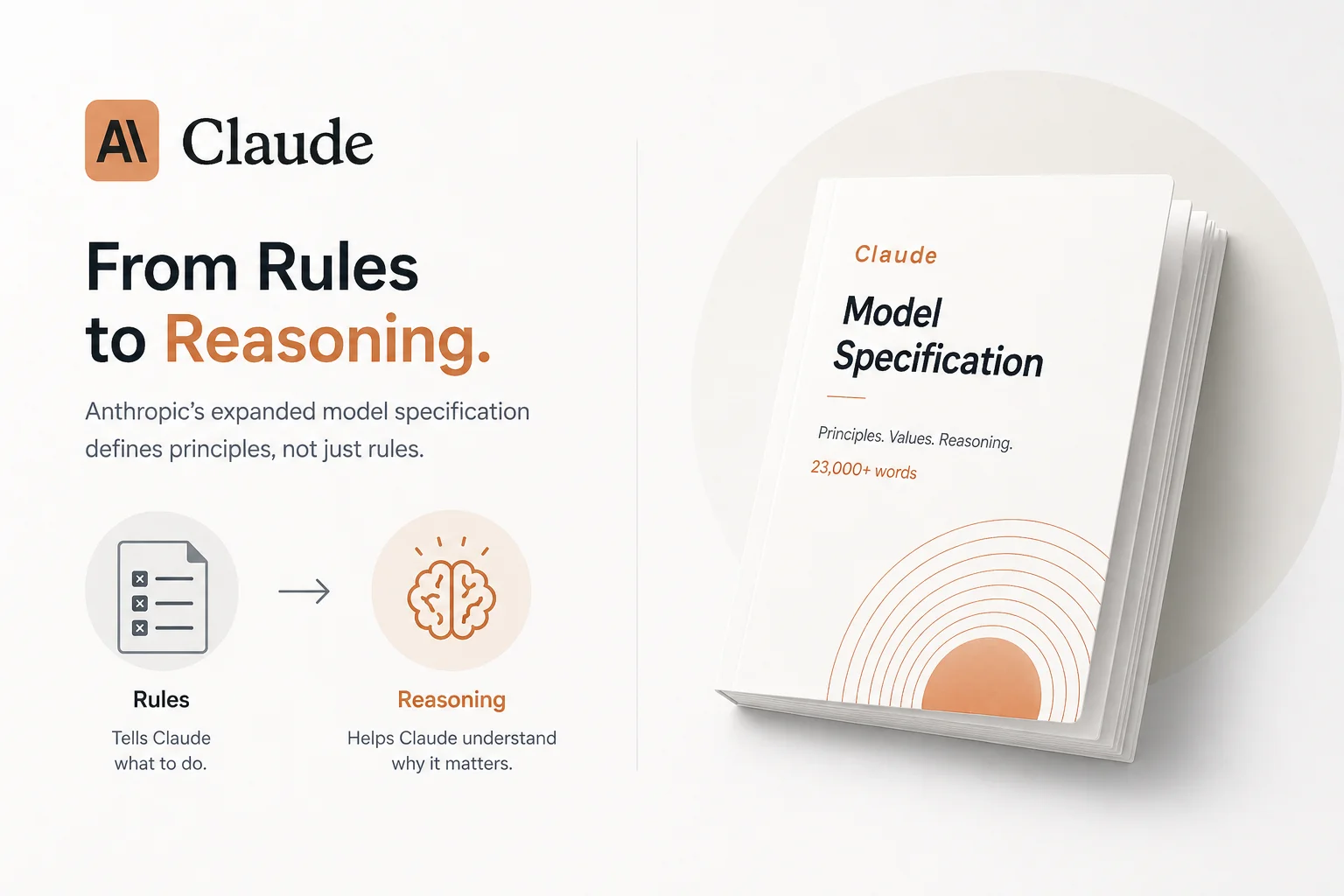
On January 21, 2026, Anthropic answered that deeper question more completely than any AI company has done before. The company released an expanded Claude model specification — its document describing the values, principles, and reasoning frameworks baked into Claude's training. The document grew from 2,700 words to over 23,000 words. More importantly, it changed from a list of rules to a framework for reasoning. Understanding what changed, and why, matters for every enterprise making procurement, compliance, and governance decisions about AI.
Most software is governed by code: it does exactly what the instructions say. AI language models are different. You cannot write a rule that covers every possible situation a model might encounter — the space of possible inputs is too large, and the edge cases are too varied. Instead, AI companies use a combination of training data, human feedback, and explicit principles to shape how models behave when they face ambiguous or novel situations.
A model specification — sometimes called a "system prompt at training time" — is the document that captures those principles. It describes how Claude should think about trade-offs: what to prioritise when honesty and helpfulness conflict, how to handle sensitive topics, when to defer to human judgment and when to act on its own, and what it should refuse to do regardless of who is asking.
Before January 2026, Anthropic's published guidelines were relatively brief — useful, but incomplete. The new 23,000-word specification is a fundamentally different document. It does not tell Claude what to do in specific situations. It explains why certain values matter, so Claude can reason through novel situations correctly rather than pattern-matching to the closest rule in its training data.
The most significant change in the new specification is philosophical. The old approach to AI safety was largely prescriptive: define a list of things the model should and shouldn't do, then train the model to follow that list. This works reasonably well for common cases. It fails at edge cases — situations where the letter of a rule conflicts with its spirit, or where following one rule violates another.
Anthropic's new specification takes a different approach. Instead of rules, it provides reasoning frameworks. Claude is trained to understand why honesty matters, not just that it should be honest. It understands the distinction between declining to answer (legitimate) and actively deceiving someone (not legitimate). It understands why confidential information should stay confidential even when the person asking seems trustworthy.
For enterprise buyers, this distinction matters in practice. A rule-following model can be manipulated — find the loophole in the rule, and the model does what you want. A reasoning model is much harder to manipulate, because it understands the principle behind the rule and will apply it even in novel framings the specification's authors didn't anticipate.
The full specification covers a wide range of principles. The following are the ones most relevant to enterprise procurement, compliance, and deployment decisions.
Claude's specification makes a strong commitment to calibrated honesty: the model should express confidence proportional to its actual certainty. It should say "I'm not certain" when it isn't. It should not confabulate sources or facts to appear more helpful. For enterprises relying on Claude for research, legal review, financial analysis, or medical information, this calibration is a foundational requirement — a model that confidently states wrong information is more dangerous than one that says it doesn't know.
The specification explicitly prohibits Claude from using persuasion techniques that exploit psychological weaknesses or biases. This includes not creating false urgency, not using emotional manipulation to guide a user toward a conclusion, and not deploying rhetorical techniques that work by bypassing rational evaluation rather than informing it. For customer-facing AI deployments — sales assistants, support agents, advisory tools — this is a direct compliance requirement, not an abstract value.
Enterprises deploying Claude often give it access to sensitive data: customer records, financial information, strategic plans. The specification addresses how Claude should handle this data — maintaining confidentiality within sessions, not volunteering sensitive information when it's not relevant to the task, and being transparent when asked what data it has access to. For CISOs and data protection officers evaluating AI vendor governance, this documented commitment to data handling principles is a meaningful differentiator.
Perhaps the most operationally significant principle for enterprise deployments: Claude's specification explicitly prioritises preserving human control and oversight, especially for consequential or irreversible actions. Claude is designed to flag uncertainty, ask for confirmation before taking high-stakes actions, and avoid optimising for task completion at the expense of appropriate human review.
This is directly relevant to enterprises deploying Claude in agentic contexts — invoice processing agents, compliance monitoring, customer onboarding — where an AI that "helpfully" skips a human review checkpoint to complete a task faster can create significant downstream risk.
For Indian enterprises operating in regulated sectors, AI vendor governance is increasingly a procurement requirement rather than a nice-to-have. The following sectors are most directly affected.
The Reserve Bank of India's 2024 circular on technology governance for regulated entities requires documented evidence that AI systems used in credit, fraud detection, or customer communication have been evaluated for bias, explainability, and control. Anthropic's published model specification provides a documented framework for exactly these properties. It does not replace a bank's own AI governance documentation, but it materially strengthens the evidence base for RBI compliance reviews.
Under the Digital Personal Data Protection Act 2023, healthcare organisations processing personal health data must demonstrate that AI systems handling that data have appropriate safeguards. Claude's non-manipulation and data handling principles directly address this requirement. Organisations deploying Claude for clinical documentation, patient triage, or health advisory applications should include the model specification in their DPDP compliance documentation.
Government procurement of AI tools increasingly requires documented evidence of the vendor's approach to transparency, accountability, and human oversight. A 23,000-word published specification that explains exactly how the model is designed to behave — and why — is a significant asset in the procurement process for government-adjacent deployments.
Anthropic's model specification sets a new baseline for what enterprise buyers should expect from AI vendors. When evaluating any AI system for enterprise deployment, the following questions — now made answerable by Anthropic's documentation — should be on your procurement checklist:
These are questions that Anthropic can now answer with documentation. They are also useful questions to ask of other AI vendors — the gap between those with published governance frameworks and those without is widening, and regulated enterprises are starting to notice.
At Infurotech, we build on Claude because its documented safety approach aligns with what our enterprise clients require. When we deploy AI applications — whether through our AI Builder service or through strategic consulting engagements — we incorporate Anthropic's model specification into our client documentation, alongside our own governance layer covering human review checkpoints, access controls, audit logging, and incident response.
For clients in BFSI, healthcare, and government-adjacent industries, we integrate Claude's constitutional principles with the specific regulatory requirements of the sector — industry-specific AI governance that goes beyond the model layer to cover data handling, access control, and operational monitoring.
The right question for Indian enterprise leaders is not "is AI safe?" — that question is too broad to be useful. The right question is "have we documented, tested, and governed how AI will behave in our specific use cases?" Anthropic's model specification is a strong foundation. Your organisation's deployment practices are the rest of the answer.
If you want help building that governance foundation for your AI programme, talk to our team. We will help you translate documented principles into operational controls that satisfy your compliance requirements and protect your business.