
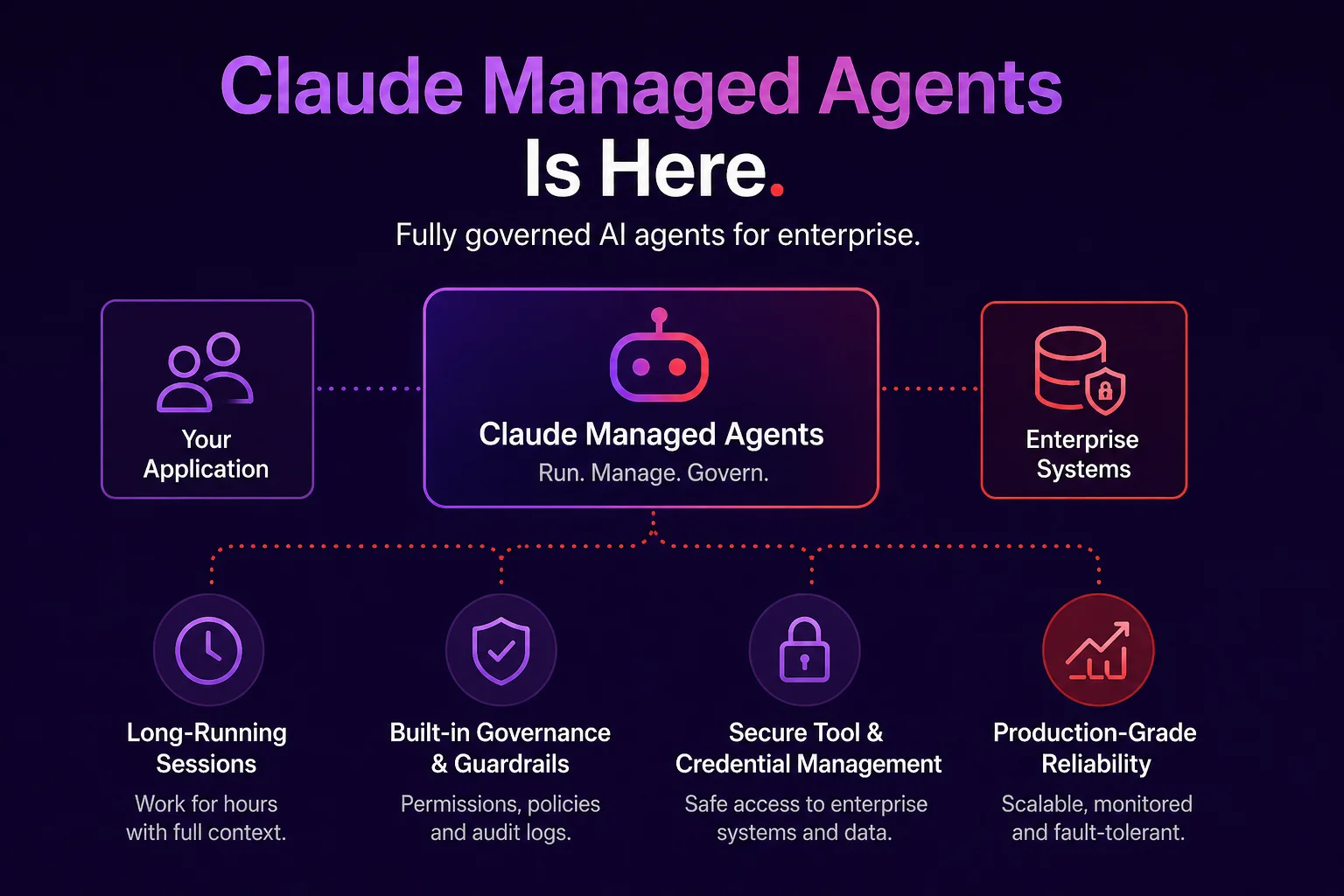
Claude Managed Agents Is Here — What Fully Governed AI Agents Mean for Enterprise
On April 8, 2026, Anthropic moved the enterprise AI agent conversation forward in a concrete way. Claude Managed Agents entered public beta — not another API endpoint, not a new model, but a fully managed execution harness for autonomous Claude agents. For enterprises that have been waiting for the production-grade scaffolding to arrive before committing to agent deployments, that wait is effectively over. This post unpacks what Managed Agents actually is, why it changes the build-versus-buy equation, and what it means for Indian enterprises ready to run agents in production.
What Claude Managed Agents Actually Is
There is a common conflation worth clearing up first. Calling the Claude API — even with a system prompt, tool definitions, and conversation history — is not the same as running a managed agent. When you call the API directly, you are responsible for everything outside the model inference itself: persisting conversation state between turns, handling tool execution, managing credentials the agent needs to call third-party systems, enforcing what the agent is and is not allowed to do, and restarting the process cleanly if something fails mid-task. For a one-turn chatbot, this is fine. For an agent that needs to work autonomously for several hours, touching five enterprise systems along the way, that responsibility stack is genuinely complex.
Claude Managed Agents is the managed infrastructure layer that sits between your application code and Claude's reasoning. You define the agent's goal, the tools it has access to, and the permissions it operates under. Anthropic's infrastructure handles everything else: session lifecycle, state persistence, sandboxed execution, and secure credential storage. The agent runs to completion — or until you stop it — without your backend needing to babysit it.
The Four Capabilities That Matter for Enterprise
Persistent State Across Multi-Hour Workflows
Claude Managed Agents supports long-running sessions measured in hours, not seconds. The agent maintains full context — the task it was given, the steps it has already taken, the results it has already retrieved, and the decisions it has already made — across every tool call and reasoning step in that session. This is not trivial. Without persistent state, an agent working on a complex task like end-to-end invoice reconciliation must either complete in a single API call (impossible for long workflows) or hand off a serialized state blob to your infrastructure between turns (which you then have to rebuild, store, and secure). Managed Agents removes that burden entirely. A session initiated at 9 p.m. for a nightly compliance run can still be working through edge cases at 1 a.m. with full context intact.
Secure Sandboxing
Each Managed Agent session runs in an isolated execution environment. Data accessed, files created, and API calls made within one session are fully contained — they do not leak into other sessions, other tenants, or your underlying infrastructure. For enterprises running multiple agents simultaneously, this is the difference between a production-safe architecture and a liability. A customer onboarding agent working on one account cannot, by design, read or write data belonging to another. Anthropic's sandboxing model is enforced at the infrastructure level, not by prompt instructions, which means it cannot be bypassed by unexpected model outputs or adversarial inputs.
Scoped Permissions
One of the least-discussed risks in enterprise agent deployments is permission creep. When an agent can theoretically access everything a service account can access, any hallucination or prompt injection that causes the agent to take an unintended action has maximum blast radius. Managed Agents enforces scoped permissions at the session level. You define explicitly which tools the agent can invoke, which data sources it can read, and which write operations it is authorised to perform. The agent cannot exceed its defined scope regardless of what it is instructed to do mid-session. For regulated industries — BFSI, pharma, government — this is not a nice-to-have; it is a prerequisite for any agent deployment.
Credential Management
Agents that interact with enterprise systems — ERPs, CRMs, payment gateways, internal APIs — need credentials to authenticate with those systems. Historically, this meant either passing credentials through your application code (a security risk) or building a secrets management layer yourself (an engineering cost). Managed Agents includes native credential management: secrets are stored securely by Anthropic, injected into the agent's execution environment at runtime, and never exposed in logs, API responses, or your application. This single feature eliminates a category of vulnerability that has caused real incidents in early enterprise agent pilots.
Pricing: When Managed Agents Makes Financial Sense
Managed Agents is billed at standard Claude API token rates plus a session fee of $0.08 per session-hour. To understand when this is cost-effective, consider the alternative: building and operating your own agent orchestration infrastructure. A robust self-hosted orchestration layer requires engineering time to build state persistence, a secrets management integration (HashiCorp Vault or equivalent), monitoring and alerting, sandboxing logic, and ongoing maintenance as the Claude API evolves. For most enterprise teams, the total cost of building and owning that stack — in engineering hours alone — exceeds years of Managed Agents session fees.
The $0.08/session-hour charge becomes material only at extreme scale. An agent running four hours per day, five days a week, 50 weeks a year accumulates roughly $80 in session fees annually. Even ten such agents running in parallel amounts to $800/year in session overhead — a negligible line item against the engineering cost of the alternative. Where the economics require more careful analysis is in genuinely high-frequency, short-duration agent tasks, where a different architecture (direct API calls with lightweight state management) may be more cost-efficient. For tasks measured in minutes rather than hours, evaluate whether the managed harness adds value beyond what a simple API call with a well-structured prompt can achieve.
What Early Customers Are Already Doing
Three early customers — Notion, Rakuten, and Sentry — were named at launch, and their use cases illustrate the breadth of what Managed Agents enables.
Notion is using Managed Agents to power extended workspace automation: agents that can reorganise content, generate structured documents from unstructured notes, and cross-reference information across a workspace over a sustained session. The persistent context is essential here — a Notion workspace is not a flat data structure, and navigating it intelligently requires building up an understanding over many steps.
Rakuten, operating at the intersection of e-commerce, fintech, and loyalty programmes, is deploying agents for customer operations workflows that span multiple internal systems. The credential management and scoped permissions capabilities are particularly relevant for a financial services context where data governance is non-negotiable.
Sentry is applying Managed Agents to engineering workflows — specifically, agents that can investigate error reports, trace through code and logs, and produce detailed diagnostic summaries without a human engineer needing to coordinate each step. The long-running session support enables the agent to do thorough investigation rather than surface-level triage.
Indian Enterprise Use Cases
The capabilities Managed Agents delivers map directly onto operational workflows that are widespread in Indian enterprises and that have historically resisted automation due to their multi-system, multi-step nature.
End-to-end invoice processing is the most immediate fit. A managed agent can be tasked with the full invoice lifecycle: reading invoices arriving via email, extracting vendor, amount, and line-item data, creating or updating the corresponding entry in the ERP, routing the invoice through the approval workflow based on business rules, and triggering payment once approval is received. This is a workflow that today involves four to six handoffs between humans and systems. With a Managed Agent handling the end-to-end invoice processing workflow, the agent holds context across all these steps in a single session, handles exceptions by querying the approver or flagging anomalies, and logs every action with a complete audit trail.
Nightly compliance monitoring is another strong fit. Regulatory requirements for SEBI-regulated entities, RBI-supervised banks, and GST filers create recurring overnight monitoring tasks: check transaction logs against compliance rules, flag anomalies, cross-reference against watchlists, and produce morning reports for the compliance team. A Managed Agent running on a schedule can complete this end-to-end without human intervention, with scoped read-only permissions to the relevant data systems and a write permission limited to producing the output report.
Customer onboarding in financial services — a process that in India typically spans KYC verification, credit bureau checks, document collection, system provisioning, and welcome communication — is a textbook multi-system, multi-step agent workflow. With persistent state and scoped permissions, a single agent session can own the full onboarding journey for a customer, moving through each system in sequence, handling verification failures gracefully, and completing the process in hours rather than days.
What You Still Need to Build
Managed Agents solves the infrastructure layer, not the integration layer. To deploy a production agent, you still need to build the tool definitions that give the agent access to your enterprise systems — the API wrappers for your ERP, the database connectors for your CRM, the webhook receivers that trigger agent sessions in response to events. You also need to build the application layer: the user interfaces where humans review agent outputs, override decisions, or receive notifications, and the monitoring dashboards that give your operations team visibility into what agents are doing and how they are performing.
Anthropic provides the execution environment. The domain-specific integration work — connecting that environment to your SAP instance, your Salesforce org, your internal approval systems — remains yours to build or to commission. This is not a limitation unique to Managed Agents; it is simply the nature of enterprise software integration. The value of Managed Agents is that it removes the need to build the hard infrastructure parts so your engineering effort can focus entirely on the integration and application layer, where the business value actually lives.
How Infurotech Builds on Managed Agents
At Infurotech, we have been working with the Claude API and agentic patterns with enterprise clients for over a year. The arrival of Managed Agents removes the largest single friction point in those deployments: the orchestration infrastructure that every client previously had to commission from scratch.
Infurotech builds Managed Agent applications end-to-end — from designing the agent's task scope and permission model, through building the tool integrations that connect the agent to your enterprise systems, to deploying monitoring and governance layers that give your operations team control. Our enterprise agent automation services cover the full deployment lifecycle, not just the initial build.
For enterprises that have existing systems — ERPs, CRMs, document management platforms, legacy APIs — the integration design is where most of the complexity lives. Our integration services connect agents to enterprise systems across the most common enterprise software stack in India, including SAP, Oracle, Microsoft Dynamics, and a range of domestic ERP vendors.
If you are evaluating whether Managed Agents is the right foundation for a specific workflow in your organisation, the most productive starting point is a scoped discovery engagement — mapping the workflow, identifying the integration points, and producing a realistic deployment estimate. Contact us to start that conversation.
The infrastructure barrier to enterprise agent deployment just got significantly lower. The question now is which workflows you want to automate first.