
AI Updates
Think about how a company manages human employees. They are hired for specific roles. Their access to systems is scoped to what their role requires. Their actions are logged. When they leave, their access is revoked. When something goes wrong, there is an audit trail. This governance infrastructure — built over decades of HR and IT practice — makes it safe to give employees significant autonomy.
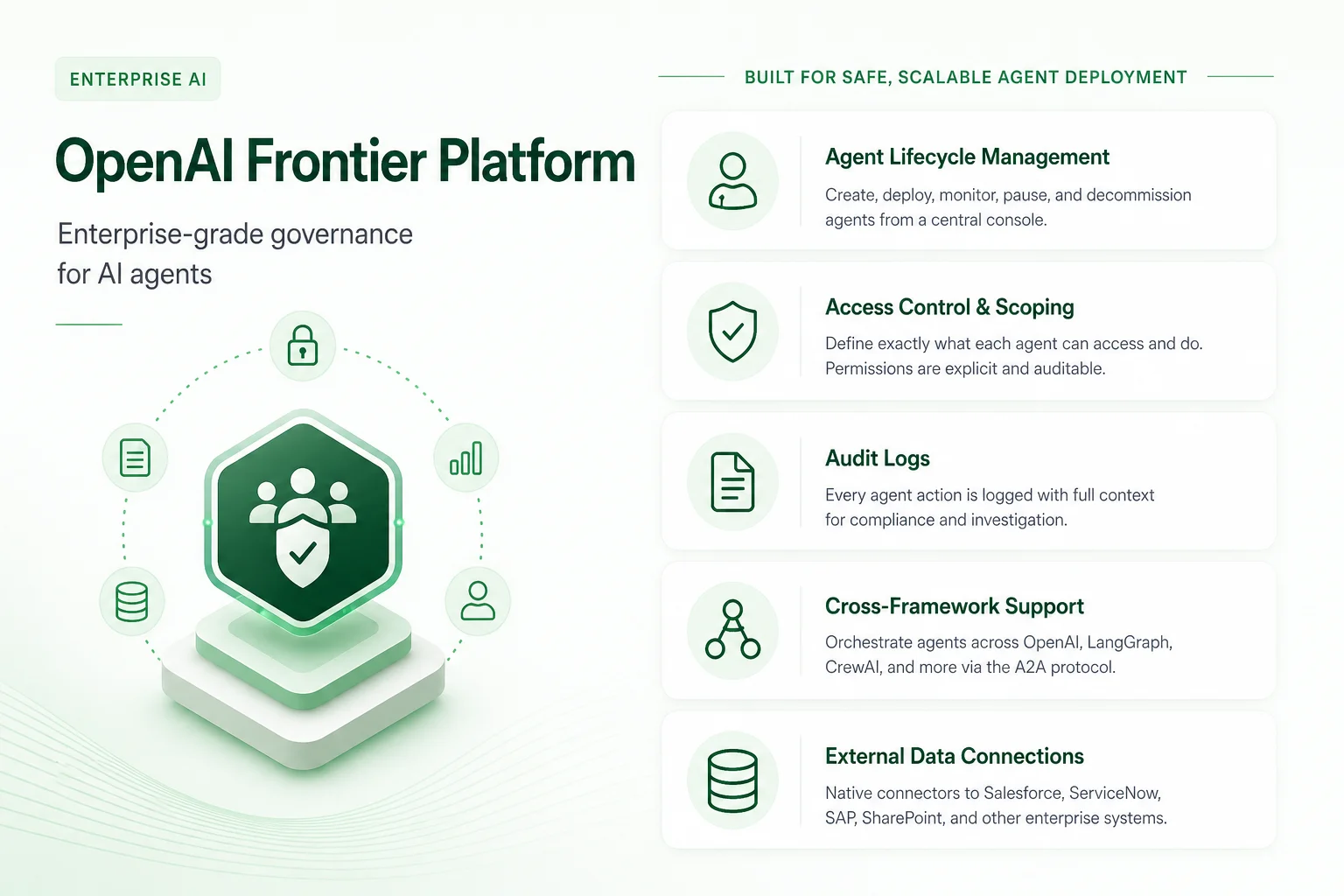
AI agents need the same infrastructure. And in February 2026, it started arriving. OpenAI launched the Frontier Platform — an enterprise-grade agent management system that treats AI agents with the same governance rigor you would apply to a human contractor. At the same time, OpenAI Operator rolled out to India, making autonomous web-browsing agents available to Indian enterprises for the first time. Together, these launches mark the moment enterprise agentic AI shifted from experimental to operational.
The Frontier Platform is not a model and not an API. It is an orchestration and management layer that sits above the AI models and provides the infrastructure enterprises need to deploy agents safely at scale.
The platform's core capabilities:
OpenAI Operator is an autonomous web-browsing agent that can navigate websites, fill forms, extract information, and complete multi-step web-based tasks on behalf of a user. Until February 2026, it was US-only. Its rollout to India opens a specific category of use cases that were previously manual:
The key limitation to understand: Operator works on websites that are publicly accessible or that the enterprise has authorised it to access. It does not bypass authentication on systems you are not authorised to use, and it cannot handle all website architectures (particularly heavily dynamic JavaScript applications with unusual interaction patterns). Test your specific target websites before committing to an Operator-based workflow.
The Agent-to-Agent (A2A) protocol — first announced by OpenAI and subsequently adopted by several framework maintainers — defines how agents built on different platforms can communicate, delegate tasks, and return results to each other.
Without A2A, an agent built in LangGraph cannot hand off a task to an Operator agent and receive results back in a structured way. With A2A, that handoff is standardised. This matters for enterprises building multi-agent workflows where different tasks require different specialised agents — a research agent (Operator), a data processing agent (LangGraph), a reporting agent (custom), and an approval agent (human-in-the-loop checkpoint) can now work together in a governed workflow.
A2A is not yet universally adopted across all frameworks, but its trajectory as a de facto standard looks strong. Enterprise architects building new agent infrastructure in 2026 should design for A2A compatibility from the start, even if they are not using multi-framework agents today.
The Frontier Platform provides the technical infrastructure for agent governance. But governance is only as good as the policies that configure it. Before deploying any agent in production, enterprises need clear answers to five questions:
An agent that sends a summary email has a small blast radius. An agent that submits a regulatory filing has a large one. Design the human review checkpoints and the permission scope around the blast radius, not around operational convenience.
Apply the principle of least privilege. An invoice processing agent does not need access to HR data. Scope permissions narrowly and expand them only when a specific task requires it.
Audit logs are the answer, but they are only useful if someone reviews them. Define who owns the agent's audit log, how often it is reviewed, and what alert conditions trigger immediate investigation.
For actions like data entry, report generation, or classification, rollback is relatively simple. For actions like form submissions, email sends, or financial transactions, rollback is complex or impossible. Map out the irreversible actions your agent takes and build explicit human confirmation steps before each one.
Define the agent's fallback behaviour explicitly: pause and notify a human, complete the task with a flag for review, or fail closed with an alert. The worst outcome is an agent that silently guesses its way through an unexpected situation and produces a result no human reviewed.
At Infurotech, we have been building and deploying enterprise AI agents since the first Anthropic agent capabilities became available. Our deployment framework incorporates the governance questions above into the design process — permission scoping, audit log configuration, human-in-the-loop checkpoints, and incident response procedures are deliverables alongside the agent itself, not afterthoughts.
For organisations evaluating agent deployments, our strategic consulting team starts with a governance readiness assessment: what systems the agent will touch, what permissions it needs, what the blast radius looks like, and whether your organisation's IT and compliance teams are ready to govern an autonomous agent in production.
For organisations ready to build, our AI Builder service delivers governed agent applications end-to-end — architecture, build, testing, deployment, and the governance documentation your compliance team needs. Our automation services team handles the integration work that connects agents to your enterprise systems, and our integration services team ensures the connections are secure, auditable, and maintainable.
The Frontier Platform and Operator availability in India have removed the last infrastructure barriers to enterprise agentic AI. The only remaining question is whether your organisation has the governance framework to deploy agents responsibly. Talk to us — we will help you build both the agents and the governance layer they need.