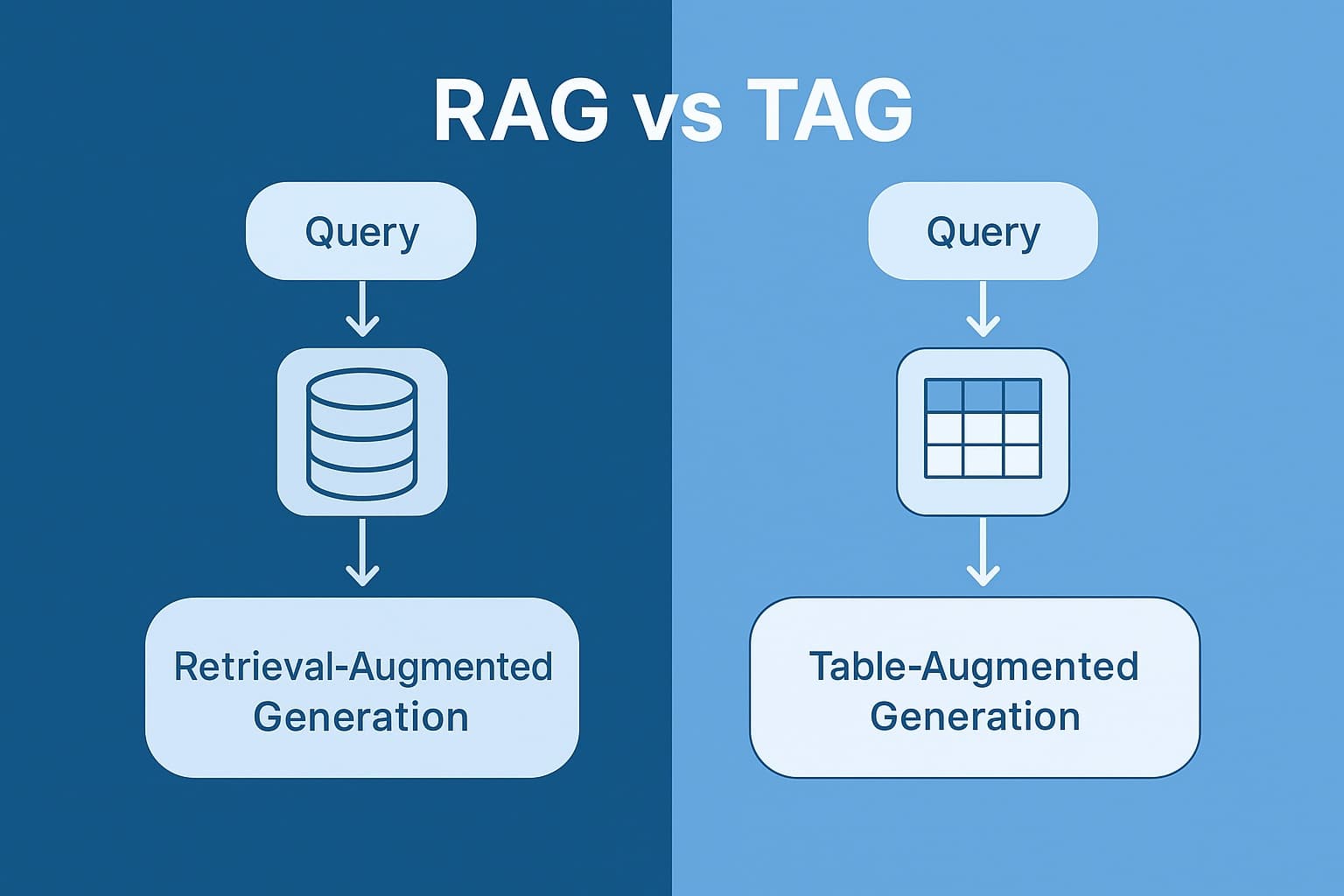
Over the last year, I’ve spent a lot of time working with clients who want to integrate AI into their enterprise workflows — not just as a fancy tool, but as a real force multiplier. During this journey, two techniques have consistently stood out when it comes to getting accurate, context-aware output from large language models:
Retrieval-Augmented Generation (RAG) and Table-Augmented Generation (TAG).
These aren’t just buzzwords — they’re architectural patterns I’ve seen make or break AI deployments. In this post, I want to share what I’ve learned about both, where they work best, and how we’ve applied them at Infurotech.
RAG: When Your Model Needs to Know More
Let’s start with RAG. The idea is simple: instead of relying solely on what the LLM was trained on, we retrieve relevant external documents and inject them into the prompt. Think of it as giving your model a custom briefing before it answers a question.
When RAG worked for us:
- A global logistics client needed their AI assistant to answer operational policy questions.
- Rather than fine-tune a model with internal PDFs and wikis, we built a vector search system using
pgvectorand let the assistant retrieve relevant snippets dynamically. - The results were dramatically more accurate — and easier to maintain.
RAG is perfect when:
- Your data lives in documents, manuals, or intranets.
- You want to minimize hallucination.
- You need flexibility as documents change.
TAG: Making Tables Talk
Then there's TAG — Table-Augmented Generation. Most organizations (including ours) are sitting on structured data goldmines: spreadsheets, reports, dashboards. Traditional LLMs struggle with tables, but TAG is a way to feed these structures to models intelligently.
We used TAG to help a fintech client:
- Automate quarterly trend summaries by ingesting raw Excel reports.
- The model learned to identify deltas, summarize changes, and even suggest strategic takeaways.
TAG shines when:
- You need insight from financials, metrics, logs, or structured reports.
- You’re tired of humans reading endless rows of CSVs.
- Your goal is data-to-text generation or natural language table querying.
RAG vs TAG: What’s the Difference?
| RAG TAG | ||
| Best for | Unstructured data (docs, wikis) | Structured data (tables, spreadsheets) |
| Input type | Natural language + documents | Tables + structured data |
| Use cases | Chatbots, support bots, knowledge QA | Report generation, KPI summaries, BI bots |
| Complexity | Medium (needs retrieval infra) | Medium (needs table formatting or encoding) |
| Risk of hallucination | Low (grounded in documents) | Low (data-driven) |
What I Recommend as a CTO
If you’re leading a tech team or planning an AI integration, here’s what I’d say:
- Start with your data. Is it structured or unstructured? That will usually guide you to RAG or TAG.
- Don’t overengineer. We’ve seen people try to force TAG when RAG would have done the job — and vice versa.
- Use them together when needed. In some enterprise copilots we’ve built, we use RAG for policy retrieval and TAG for summarizing performance dashboards — it’s incredibly powerful.
Final Thoughts
As CTO, my job is to make sure we choose the right tools for the right context, not just chase hype.
RAG and TAG are both incredibly valuable — but only when matched to the problem they’re designed to solve.
At Infurotech, we’ve deployed both approaches in live enterprise environments — from helping execs navigate compliance docs to turning spreadsheets into natural conversations.
The future of AI in the enterprise won’t be about one model — it’ll be about how intelligently we augment it.
If you’re exploring RAG, TAG, or building AI systems that are more than demos, feel free to reach out. We’ve walked this path — and we can help shorten yours.